This week, around 900 executives from the mechanical and plant engineering sectors are gathering in Berlin for the 16th German Mechanical Engineering Summit. One of the sessions is titled with a question that is currently on the minds of many executives: “Digitalization & AI in Practice: What Are the Real Benefits?”
That’s a valid question. In February 2026, the VDMA surveyed 248 companies in the industry. The findings regarding artificial intelligence:
- 31 percent use AI productively.
- 37 percent are allocated to pilot projects.
- 18 percent plan to get started before the end of this year.
Source: VDMA survey “Digital Transformation in the Machinery and Plant Engineering Industry 2026, ” presented on April 21, 2026.
So more companies are running pilot projects than actually using AI in their day-to-day operations. Anyone who has ever overseen a production launch is familiar with the pattern: The prototype is running on the workbench. Mass production is still a long way off.
The problem is rarely the technology
It is interesting to note what companies cited as obstacles in the same survey. Not a lack of algorithms, but change management (47 percent), speed of implementation (44 percent), and a lack of human resources (42 percent). The VDMA itself sums it up this way: The biggest obstacles lie “not in the technologies.”
Prof. Doris Aschenbrenner of Aalen University, who will be speaking at the summit during the AI session, used an analogy in an interview with PRODUKTION that everyone can relate to: “Many AI solutions right now are like a personal Excel file with very powerful features.”
That hits the nail on the head. A pilot project is usually developed by a dedicated individual, using their own data, for their specific task. It works. But it’s tied to that person, isn’t connected to any system, and has no designated owner within the process. As soon as that person goes on vacation, the pilot project comes to a standstill.
There’s a second figure that ties into this: According to the VDMA, about 65 percent of machine builders develop their own AI solutions using existing software tools (VDMA Position Paper on Industrial AI, April 2026). This is a strength because the knowledge stays in-house. But it also explains why so many solutions remain siloed.
A pilot project is a prototype, not a production process
I have a background in engineering: over 20 years in the industry, ranging from start-up planning to leading global engineering teams. My first major project was a Kanban pilot at an automotive plant. On the first day, as we walked through the production floor, my supervisor told me something to the effect of: “You’re running the pilot, but this is supposed to be rolled out to full-scale production later, and I can’t imagine it working given how complex it is.”
What made the difference wasn't the method. I didn't set up my desk in the planning office; instead, I set it up among the twelve foremen. There, I listened to their problems every day. After four weeks, we had mapped out the value streams together, and the rollout was their project, not mine.
It's the same with AI today. A pilot project proves that something is possible. It can only make its way into everyday use if it has the three things every production process needs: a reliable data source, someone responsible for the process, and people who are willing to work with it.
What this demonstrated at FEW Automotive
We saw how this plays out on a large scale at the FEW Automotive Group, an automotive supplier with five plants on three continents. Before we set up the system together, the plants were working with separate Excel spreadsheets. A single failed project resulted in 600,000 euros in losses because no one noticed in time that it was falling apart.
Today, more than 200 projects are managed in a shared database, with consistent standards across all plants. The solution was presented as a best practice at Smartsheet ENGAGE in Seattle in 2025.
Here, too, the key wasn't the tool. It was a common standard, a single source of truth, and clear lines of responsibility at each plant. It is precisely this foundation that most AI pilots lack. Without it, any AI remains nothing more than a personal Excel file with very good features.
Five Steps from the Cockpit to Everyday Life
Based on our work with medium-sized industrial companies, we’ve identified five steps that have proven effective. These steps apply regardless of which AI tool you use.
1. Choose a process, not a tool
Don’t start by asking, “What can AI do?” Instead, start with a process that’s currently painful and repetitive: clarifying quotes, change management, project status, complaints, and service cases. Anything where people have to gather information from multiple sources before they can make a decision is a good fit.
2. Take measurements before starting and establish a criterion for stopping
Note how long the process takes today, how many hours it takes per week, and how you’ll measure success. In the same interview, Prof. Aschenbrenner recommends defining the baseline, target, measurement method, and termination criteria before the project begins. If you don’t do this, after three months you’ll be discussing impressions instead of numbers.
3. Connect the pilot to the systems you already have
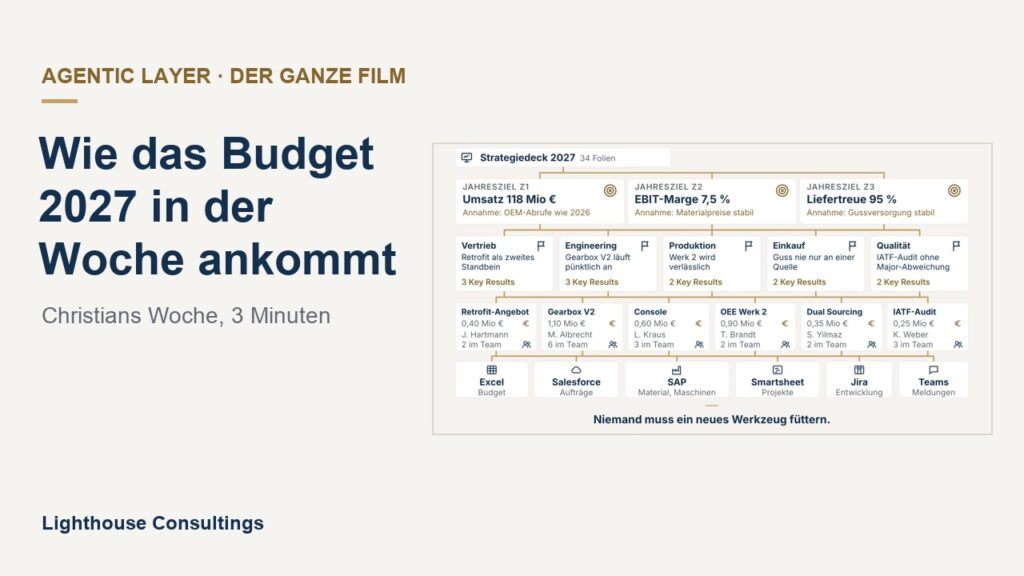
A pilot project based on copies becomes outdated on the very first day. AI needs to read the information right where it already exists: in the ERP, in the CRM, in the project management system, and in the inbox. That’s exactly what we mean by an “Agentic Layer”: a layer on top of your existing systems that consolidates information, organizes it, and prepares options. It doesn’t replace software—it connects it.
4. Determine who makes the decisions
AI categorizes, calculates, and makes suggestions. A person makes the decision. Define the thresholds at which approvals are granted, and log each approval with the approver’s name, the time, and the reason. This builds trust within the team and ensures that decisions remain transparent even months later. Our article “Budget 2027 Approved: Will the Plan Hold Up This Week?” shows how this works in everyday practice.
5. Empower the people who work with it
If 47 percent of companies cite change management as their biggest hurdle, then employee empowerment needs to be included in the project plan—not left until the end. A proven approach involves having a few key users per department who learn through their own processes rather than through hypothetical examples, and setting a fixed date for the team to demonstrate the improvements they’ve made on their own. We describe how we introduce teams to Claude on our page about Claude training.
How to Tell When a Pilot Has Settled into Everyday Life
Three simple questions can help:
- Does it work without its inventor? Even if that person is on vacation for two weeks, the team still uses it.
- Is it reading from the system? The data comes from the source, not from a copy from last Monday.
- Is it reflected in a key performance indicator? The effect appears in a report that management reads anyway.
If all three answers are “yes,” the prototype has become a production process. We call this gap between what has been decided or proven and what actually happens in day-to-day operations the “execution gap.”
How We Can Help
Lighthouse Consultings supports medium-sized industrial companies in the DACH region on this journey. We are a Registered Partner in Anthropic’s Claude Partner Network and implement Claude solutions in a way that integrates them with your existing systems and enables your team to manage them independently. You purchase Claude licenses directly from the manufacturer; we handle the concept, integration, and training.
Do you have a pilot project that’s having trouble getting off the ground? Schedule an initial consultation. In 30 minutes, we’ll review the process together and figure out what’s missing to get it up and running.
Frequently asked questions
What prevents an AI pilot from being deployed in production?
A pilot demonstrates that a task can be solved using AI, usually with one person and the organization’s own data. The implementation is effective when it is integrated with existing systems, has a designated owner within the process, operates independently of its creator, and its impact is reflected in a key performance indicator.
What are the most common reasons for the failure of AI projects in mechanical engineering?
According to the 2026 VDMA survey, the top non-technical barriers are: change management (47 percent), speed of implementation (44 percent), and a lack of human resources (42 percent). In addition, 60 percent of companies cite IT security requirements as a challenge in digital transformation.
What is an agentic layer?
An Agentic Layer is a layer that sits on top of a company’s existing systems—such as ERP, CRM, project management systems, and email. It consolidates information, assigns it to goals and projects, and prepares options. Decisions are still made by a person, and every approval is logged.
Do we need to implement new software for this?
No. The Agentic Layer integrates with the systems you already use. For Claude itself, you'll need licenses, which you can purchase directly from Anthropic.
Which process should mechanical engineers start with?
A process that is repetitive, currently takes a measurable amount of time, and involves people compiling information from multiple sources—such as clarifying proposals, change management, project status, or service cases.
As of November 10, 2026. Figures: VDMA survey “Digital Transformation in Mechanical and Plant Engineering 2026” (February 2026, 248 companies) and VDMA position paper on Industrial AI (April 2026).