I have a background in engineering. In my industry, no equipment is commissioned until the foundation, power supply, and quality plan are in place. No one orders the machine first and then asks where it should be placed.
With AI, it often works the other way around. A typical scenario: The head of operations at a supplier launches a pilot project. Licenses for 50 colleagues, an assistant to manage the order data, initial enthusiasm. Three months later, management asks what the project has accomplished. No one can answer. There were no targets, no data rules, and no one assigned to take responsibility.
This example is a model, not a specific company. The Gartner overview “AI Roadmap at a Glance” (2025) illustrates why this happens so often.
What Gartner Shows, in Our Own Words
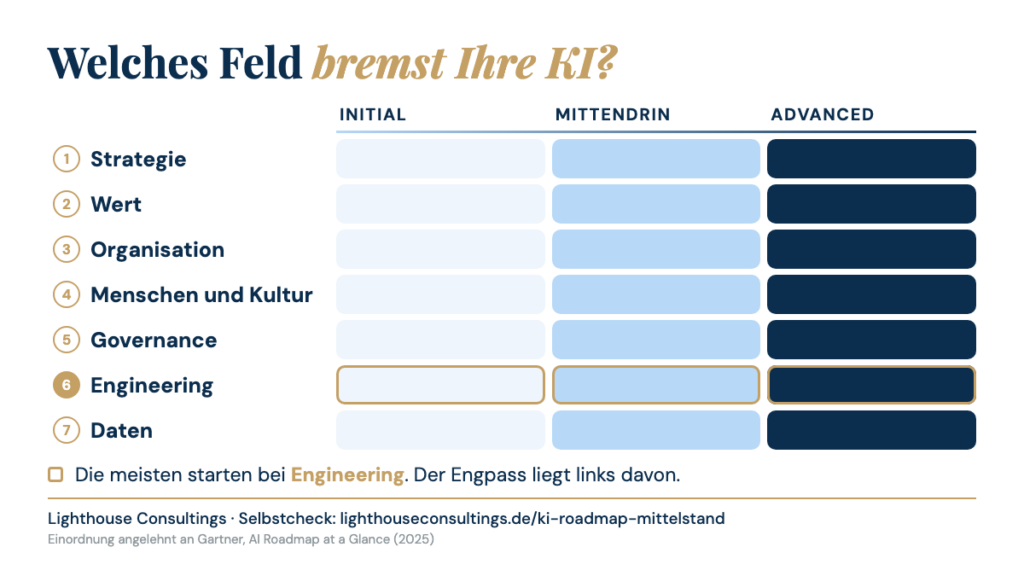
Gartner categorizes AI in the enterprise into seven areas: strategy, value, organization, people and culture, governance, engineering, and data. For each area, there are activities ranging from “Initial” (first steps) to “Advanced” (mature, sustained operations). You can find the original graphic on Gartner’s website: AI Roadmap, How to Build and Scale AI. We’ve summarized it here in our own words.
Our observation among small and medium-sized businesses: Most jump straight to the “Engineering” column—that is, tools, pilot projects, and licenses. Strategy, people, governance, and data remain in the left column. The execution gap—the gap between plan and impact—does not lie with the tools. It lies between “Initial” and “Advanced.”
Where do you stand? The seven-part self-assessment
The fastest way is to do it interactively: 21 clicks, and then you'll see your profile, your bottleneck, and the next step. Prefer a paper copy? Download the self-assessment as a PDF (3 pages to check off).
Questions to review:
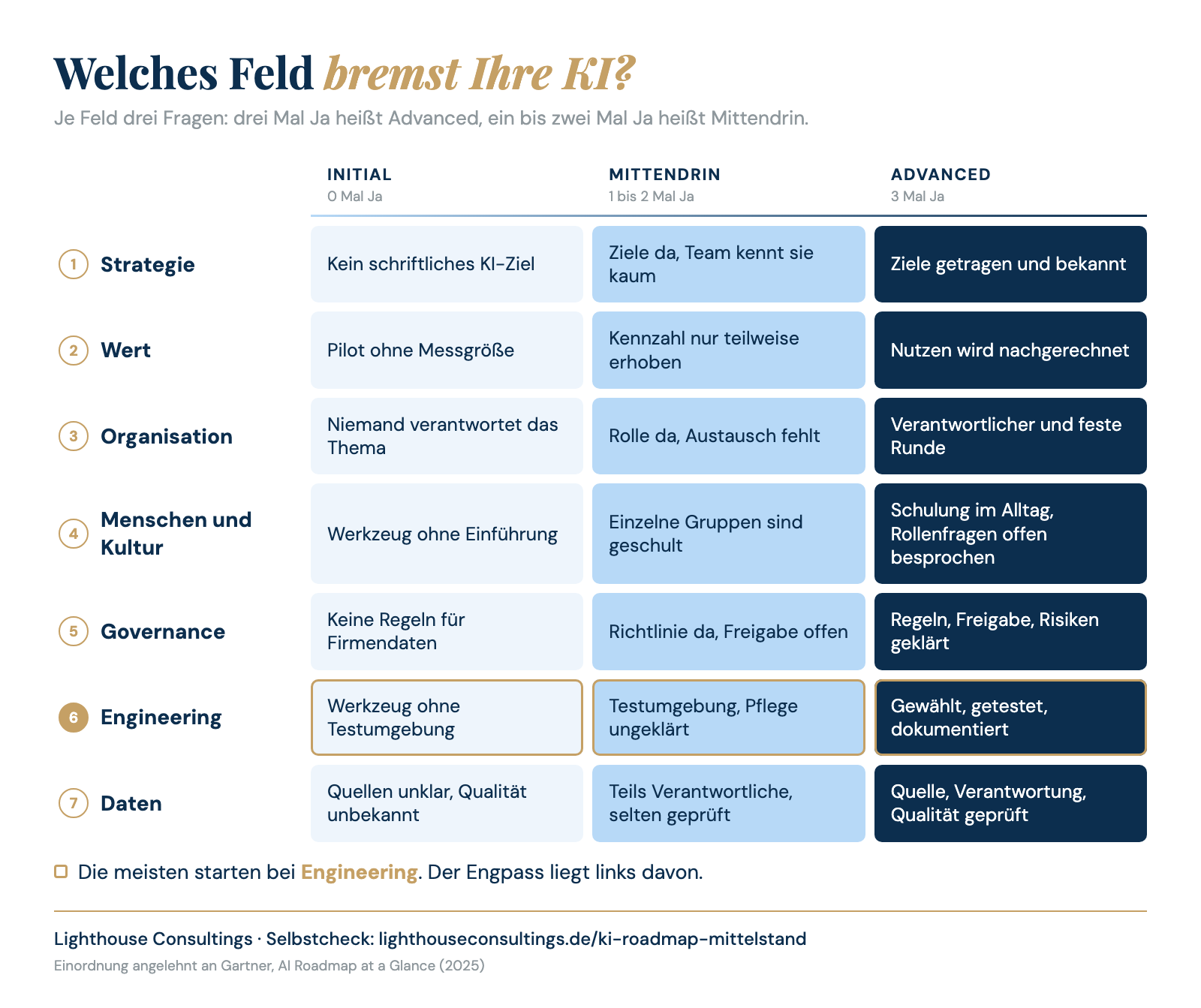
How to use this list: Three questions per field. Three “Yes” answers mean you’re on your way to the “Advanced” level. One or two “Yes” answers: You’re right in the middle. Three “No” answers: “Initial”—and that’s exactly where it’s worth taking the next step.
1. Strategy. You know what you want AI to accomplish for your organization: two or three goals that can be used as benchmarks later on, such as reducing the reporting workload in the PMO or generating quotes more quickly.
- Is there a written AI goal that management supports?
- Does your team know the priorities?
- Do you know where you stand today?
2. Value. Every effort has a benefit that someone can quantify. A pilot without measurable metrics is just a demonstration.
- Is there a "before" and "after" metric for each use case?
- Does anyone evaluate the benefits after three months?
- Do you prioritize based on impact, not enthusiasm?
3. Organization. One person takes the lead on the topic, and there is a central hub where experiences are shared. With 300 employees, a single role with a clear mandate and a monthly meeting are often sufficient.
- Has a data controller been designated?
- Do users regularly share information with one another?
- Is it clear who selects external partners?
4. People and Culture. AI only works if people use it safely. This requires training tailored to their day-to-day work and honest answers about how their roles will change.
- Has each user group received an introduction tailored to their own daily work?
- Is there anyone in any field who helps others?
- Do you talk openly about changes in your responsibilities?
5. Governance. Clear rules: What is allowed? What data can be used in which tool? Who decides on exceptions? This isn’t a roadblock—it’s the reason why business units can move forward with confidence.
- Is there a one-page policy for company data?
- Has it been determined who approves new tools?
- Do you know the key risks associated with your use cases?
6. Engineering. Tools, integrations, operations. This is where almost everyone starts, and that’s fine as long as the fields to the left of it grow along with it.
- Do you know why you chose this tool?
- Is there a test environment where mistakes don't cost anything?
- Is there a record of who maintains the applications?
7. Data. Good tools produce poor results when fed poor data. Where is the order, project, and quality data stored? How up-to-date is it? Who is responsible for it? Often, the honest answer is: in numerous spreadsheets and email inboxes.
- Do you know the source of the data that the AI is supposed to access?
- Is there ever a person responsible for a dataset?
- Do you check the data quality on a regular basis?
Which field first?
Not the task that’s the most fun, but the one farthest to the left—the one that’s holding the others back the most. To address this, identify the next action step, along with the person responsible and a deadline. One is enough.
An analogy from the field: A production line runs only as fast as its narrowest bottleneck. In AI, the engineering side is rarely the bottleneck because it’s the most visible and gets the most attention. The bottleneck is usually found where no one is looking: in missing goals, unclear data rules, or teams that don’t know how to use the tool in their day-to-day work. Tackling these issues yields greater results than purchasing another license.
A real-world example: FEW Automotive
At FEW Automotive Group, we have established a uniform standard for continuous improvement across three continents and five plants. At its core is a gate-review system with clearly defined outcomes for each stage, which runs on Smartsheet. Together with Konstantin Gross, Group Program Manager at FEW, we presented our story at Smartsheet ENGAGE 2025 in Seattle.
Why this matters: The standard came before the tool. First came the rules, roles, and results; then came the technology; and today, the teams are staying on course on their own. This isn't an AI project, but it follows the same sequence that an AI roadmap requires.
If you'd like to take a look from the outside
The self-assessment works on its own. If you’d prefer to go through the seven sections together, you can schedule a free initial consultation with us to review the results side by side and determine the next step. We are a Registered Partner in the Claude Partner Network. We do not provide licenses; please contact Anthropic directly to determine your licensing needs.
Schedule an initial consultation
Source: Gartner, “AI Roadmap at a Glance,” © 2025 Gartner, Inc. The classification and self-assessment are our own interpretation.