These days, many management teams are reviewing the final budget slides. Approved, decided, filed away. And then Monday rolls around. The question the advisory board will ask in the spring isn’t whether the budget was calculated correctly. It’s: Is the plan holding up?
Our new video series explores this question. It's set in a fictional company and addresses a problem that exists almost everywhere.
Christian's Week
Christian Brenner is the CEO of Brenntal Antriebstechnik, which has 640 employees. Brenntal and all the people mentioned in this article are fictional; the figures are taken from our demo model. Christian’s 2027 budget has been approved. Nevertheless, his week looks like this: 143 emails, 34 appointments. He doesn’t have a single hour left for the initiative on which the revenue target depends.
The strategy is in the deck. The week belongs to the mailbox. Something is missing in between.
We call this gap the “Execution Gap”: the discrepancy between what has been decided and what actually happens during the week. It doesn’t result from negligence. It arises because budgets, goals, projects, and calendars are stored in different systems that aren’t connected to one another.
You can watch the entire video here (2:52 minutes):
The Thread: From Budget to Work
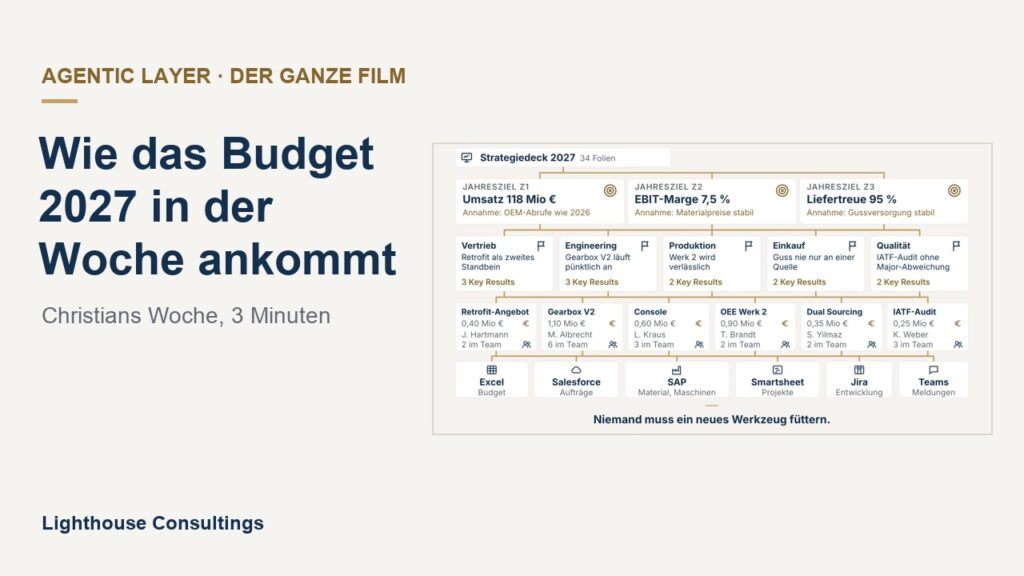
An Agentic Layer is a layer that sits on top of the systems you already have. It does not replace any software. It connects what’s already there into a chain that can be read from top to bottom:
- Budget: the approved figures for 2027.
- Annual goals with assumptions: Brenntal has three goals, including revenue and on-time delivery. For each goal, there is a note explaining what it is based on, for example, “Automakers are placing orders at the same rate as last year.”
- Quarterly OKRs by department: measurable Key Results and a confidence rating on a scale of zero to ten, as assessed by the team itself.
- Initiatives: with a budget, a project lead, and a team.
- Work: in the systems where it’s already happening today. The budget in Excel, orders in Salesforce, materials and machinery in SAP, projects in Smartsheet, development in Jira, and coordination in Teams.
Claude reviews the strategy document and proposes this cascade. Management reviews it, makes changes, and approves it. From then on, it serves as the benchmark against which everything is measured. No one has to feed data into a new tool.
Three Directions That Get Lost in Everyday Life
A plan must be evaluated from three perspectives. In everyday life, usually only the first one is considered.
Planning from the Top Down: The Budget Process
Petra Lang is in charge of finances. The sales department wants to launch a service portal for 0.45 million €. The budget has been allocated, and the reserve is small. The usual procedure would be an Excel review with three opinions and a postponement.
In the Agentic Layer, Petra sees the effect immediately: If she puts the console prototype on hold and allocates funding to the portal, the revenue forecast rises from 118.0 to 118.8 million euros, and the team’s workload drops from 79 to 19 hours. It’s like retooling a production line: You don’t just reconfigure a machine; you calculate in advance what will come off the line at the end.
Start from the bottom: Call and check-in
Tuesday, 9:12 a.m. The foundry calls to say the cast housings will arrive three weeks later. For Markus Albrecht, Head of Engineering, this used to mean: phone calls, Excel, coordination meetings—three days until everything was clear.
The Agentic Layer pulls on precisely this thread. It assigns the report to the initiative and calculates the consequences all the way up the chain: The production launch is pushed back from March 15 to April 5; within the team, the first prototype conflicts with the IATF audit; and on-time delivery drops from 95 to 93.5 percent. Claude presents three options for each objective, including costs and impacts. A rule stipulates that management makes the decision for amounts over €50,000. Christian selects the secondary supplier for €68,000 from the reserve, and the start of series production remains on March 22. Everything is documented.
The second measurement is less cumbersome. Katrin Weber is guiding Brenntal through the IATF audit. Until now, that meant a 12-slide status report every Friday. Now it’s a two-minute check-in. The actual value comes from the project system, along with her confidence. If it drops, management sees it the very same day.
I'm familiar with this pattern from my own experience. During my time in the industry, the monthly project review took a whole week of report writing, and by the day of the meeting, the slides were already out of date. A check-in that pulls the actual data from the system puts an end to exactly that.
Looking at it from the outside: the market
Christian's revenue target is based on one assumption: that automakers will place orders at the same rate as last year. In January, orders were down eight percent. In most companies, this is noticeable in the quarterly report. By then, three months will have passed.
The Agentic Layer places the assumption alongside the report. The forecast drops from 118.0 to 116.6 million euros, and management is faced with a choice: adjust the target or change course.
Claude does the math; a person makes the decision
The same division of labor applies to all three areas. Claude assigns tasks, runs calculations, and prepares options. Christian, Petra, Markus, and Katrin are responsible for making decisions. Each approval is logged with the name, date, and reason, and a new version of the plan is created. This way, even months later, it’s still clear why the production start date is March 22.
In the end, the thread comes full circle to where it broke: Christian’s week. The manager now knows what matters. Out of 143 emails, nine require a decision. The 34 appointments have been whittled down to 21; dedicated time has been set aside for the at-risk goals, and Friday afternoon is free.
Friday, 4:00 p.m. Christian replies to his advisory board: Yes, we're on track. On-time delivery rate: 94.9 percent; production start: March 22.
What this means for your business
Brenntal is fictional. The question on Friday at 4 p.m. is not. If you want to check whether your 2027 budget will be approved this week, here are three questions to help you:
- Is there an underlying assumption for each annual goal, and does anyone review that assumption before the quarterly report is issued?
- How long does it take at your company from the time a supplier submits a proposal until a decision is made with specific figures?
- How many hours per week does your team spend on status reports that simply copy and paste the actual figures?
We’re introducing the Agentic Layer as a standalone initiative: It runs on Claude and integrates with the systems you already use. We describe how this layer between systems and employees works on our Agentic Layer page. Our Claude training sessions show teams how to use Claude.
Want to see how this applies to your own goals? Schedule an initial consultation. In 30 minutes, we’ll work through one annual goal together, down to the details of how to implement it.
You can find all six episodes of the series in our YouTube playlist.
Note: Brenntal Antriebstechnik and all individuals are fictional. The figures were calculated using our demo model and do not represent customer data.